Given the title and nature of my last post the subject of this one was fairly predictable, yes?
My 2017 calendar has been filling up already, as I'm sure yours is too. Here is what I'm looking forward to participating in/ helping with in the following months:
Jan 7 - Anglespur - Concordia Yule Pot-Luck, shire of Anglespur. Games, Friends, and Food, in garb. What more needs to be said?
Feb 4 - at the sign of the Dancing Fox XIX, Shire of Nordenhalle. Dancing, Friends, Dancing, Feast, and Dancing. Fun times. I may be going by myself, as my husband is not that much interested in dancing. Also, depending on the kids' work schedules, they may need a babysitter. Who knows, I may have a short dancing partner for the day.
Feb 11 - King and Queen's A&S and Bardic Champions, Barony of Concordia of the Snows. We get to host this. Come! It will be awesome! I will be volunteering in the A&S room, so look for me there. No babysitting for me this time.
Mar 11 - Novice Schola & Birthday Feast, Barony of Bergental. I will finally be teaching my First Class! It will be on those multi-century, ever pervasive, eyelets. Photos of paintings and extant garments with them shall be available, examples in my own garments, and hands-on lessons will make up the class time.
Mar 25 - Laurel's Prize Tourney, Barony of Carolingia. I'm entering this one. *gulp* There are two challenges that fall within my field of interest: "Making Old Garb New", by Mistress Cassandra Grey of Lochleven, and "Under it All", by Mistress Agatha Wanderer. Documentation for the latter would be difficult for my late 12th-century persona, but would be an interesting exercise. While I've been playing for just over five years, I do have an early-made dress that has a lot about it that could be improved upon, including being made a size larger so it fits me. I'll have to decide which one I'm going to do within the next week and get going on it.
Pennsic may not happen this year for us. We have a family reunion happening in Hannibal, MO in June which will eat up both funds and vacation time. If it's the case that we don't go, it will seem to set a pattern of going to Pennsic every other year.
In the next weeks I will have to:
1) Pull together class materials and produce examples of different types of eyelets
2) Make something for the Laurel's challenge. That may be a dress with eyelets on the sides and embroidered sleeves.
3) It would be really cool to finish my brown dress for the K&Q A&S/Bardic event so as to have something new to wear.
See, this year promises to have lots more to post about on my adventures in sewing and research.
If you're at any of these events, come by and say hi!
~ Marjorie
Friday, December 30, 2016

Tuesday, December 27, 2016
The Old Year Passeth
The end of an event-filled 2016 is fast approaching and I have a few moments to catch my breath before the new year arrives, with it's share of happenings and Events. This past year included:
Receiving our AOAs at our first Birka. Our friend had to find my husband because he hates court and was hibernating elsewhere on site.

Our son's wedding in April, for which I made my dress. Because he needed help with the arch, I left a day earlier than planned, toting my sewing machine, half-made dress and iron with me.
 The birth of our first grandchild, three weeks early. Which nixed me teaching my first class. It would have happened the following weekend at Wars of Roses. Still haven't taught that "First Class".
 Pennsic XLV, for which I made a rope bed for us (thanks to John fitz Thomas for all his help, and access to the COG in Troy). It did what all rope beds do, it S-A-A-G-G-E-D. I have plans to modify it to a slat bed for next time.
Pennsic also included my first A&S display, which I have previously mentioned here.
 Shortly after Pennsic, I took my grandson to his first event, Hunter's Moon, in the Shire of Anglespur. He had a grand time and charmed all who met him. I also learned a thing or two about making garb for wee ones which I will share when I have a few more examples finished.
 Then life went sideways when my daughter and her family, including cat, moved back home while they were in between apartments. I still haven't recovered and they're still with us.
 And here they are! My husband's red running pant. I have plans to make the complete Pantalone ensemble in the future, but this is what he wore for the Troy Turkey Trot on Thanksgiving day. I was up until 3:30 am hand-sewing them and somehow still managed to host our son and his wife that day.
 That brings us up to Christmas and the main present-receiver of the day. He's wearing a pair of slippers I crocheted for him based on a photo I saw.
With smiles like that every day, do you wonder why I like my life?
This year I also committed to being our barony's Chronicler and Clerk for two years, which means I get to be my own boss, or my own minion, depending on how you look at it.
Next year is already shaping up to include more sewing and apprenticing than this year has. Thank you, God! I'll have more things to blog about.
Wishing you a safe and healthy New Year,
~ Marjorie
 |

Our son's wedding in April, for which I made my dress. Because he needed help with the arch, I left a day earlier than planned, toting my sewing machine, half-made dress and iron with me.


Pennsic also included my first A&S display, which I have previously mentioned here.


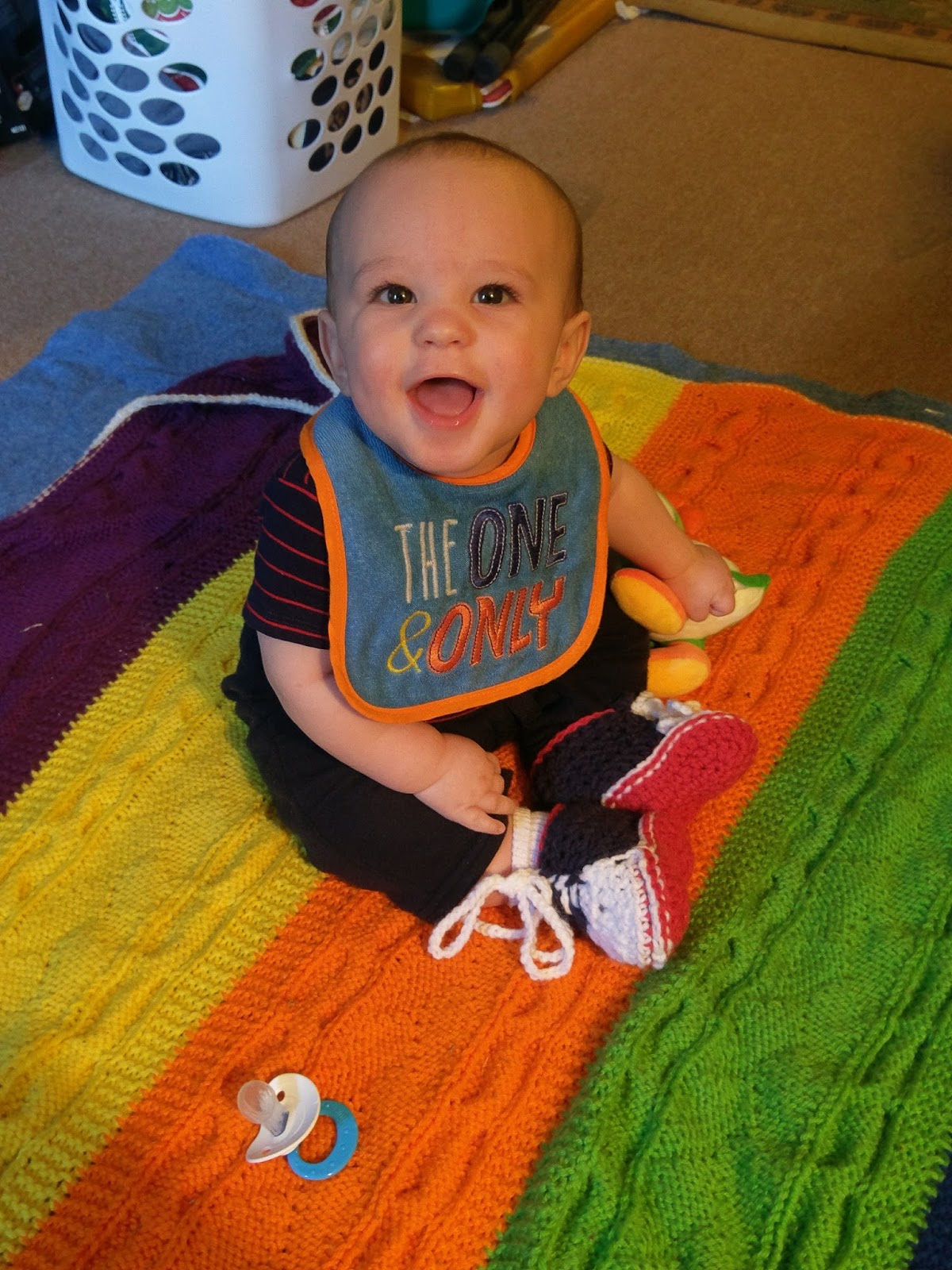
With smiles like that every day, do you wonder why I like my life?
This year I also committed to being our barony's Chronicler and Clerk for two years, which means I get to be my own boss, or my own minion, depending on how you look at it.
Next year is already shaping up to include more sewing and apprenticing than this year has. Thank you, God! I'll have more things to blog about.
Wishing you a safe and healthy New Year,
~ Marjorie
Thursday, November 17, 2016
Running Pants
My husband likes to run. He is also hooked on this medieval game of ours. His persona, Temyl von Zweibrücken, is from 16th century Germany and is a commedia dell'arte performer. On Thanksgiving Day he plans to combine the two and run a 10K dressed as one of the Commedia stock characters, specifically, Pantalone. He's already ordered a red fez and a Pantalone mask. Now I get to make red pants for him.

Pantalone is usually portrayed in red tights, and I will eventually make these for him.
But for this occasion, we're going with the pants version.
I'll use the same pattern I used for his plunderhosen, only put less material around each leg.
 Here he is from Pennsic 45, playing Pantalone. He really needs red garb!
I'm off to the cutting table.
~ Marjorie

Pantalone is usually portrayed in red tights, and I will eventually make these for him.
But for this occasion, we're going with the pants version.

I'll use the same pattern I used for his plunderhosen, only put less material around each leg.
I'm off to the cutting table.
~ Marjorie
Wednesday, September 14, 2016
Life...and Pennsic A&S Display
L-I-F-E happens. And tends to put a big dent in hobby-time. In my case, Life was my daughter's pregnancy, my son's wedding, and the birth of my first grandchild three weeks early. And then came Pennsic.
Pennsic, as you most likely know by now, was hot! I had plans of relaxing and writing, but the heat so sapped my strength, that I barely made it to the classes I wanted to attend and the must-do shopping while at Pennsic.
At the insista...(cough, cough) encouragement of my Laurel, I entered the wool dress I had made over the winter in the A&S Display on War Sunday.
 This is a late 12th-century English dress with side-laces and beadwork at the neckline. The sleeves are tighter fitting with underarm gussets. The skirt has front and back gores, as well as at the sides. The main body of the dress was cut as one long piece and has no shoulder seams. Everything is hand sewn.
Two main things I took away from constructing this dress:
- I LOVE working with wool. Seams were sewn by overlapping the pieces and stitching down the edges. No elaborate finishing needed.
- Wool likes to heal itself. Using an awl to stretch the holes for the eyelets wasn't enough. If I didn't quickly tack open the opening at the four cardinal points (N,S,E,W or 12,3,6,& 9 o'clock positions) the wool would close back to its original shape, something linen doesn't do to me. I overcompensated on a few eyelets until I caught onto the best method. Consequently, some of the eyelets are oversized or misshapen.
Many people stopped by to talk with me, from the young girl who was there with her mother and so very excited about giving me a bead, to laurels and A&S Champions of all levels. I answered every question as best I could, justifying my styling and methods.

Two main things I learned:
- Document, document, document. I had researched paintings, illuminations, and read research and suppositions of other SCAdians, but none of it came with me in written form. I had to pull it all out of my head as I talked. I could not remember individual sources or examples. While I could say with confidence that there are extant period ecclesiastical garments with beading, I could not recall where they were from. Written documentation will be a must in the future, even for a Display, as opposed to a Competition.
- Create a pleasing display. This includes the tablecloth, documentation, and any other aspects that will better present my work. I'm planning to finish off the edges of the material I bought last-minute to cover the table, and make something else that is larger if I happen to have more space next time. I'm a large woman, and my clothes take up a lot of table space. I need a proportionally large table covering.
I will close with a photo of the main distraction in my life now, my grandson, B.
 YIS,
YIS,
~ Marjorie
Pennsic, as you most likely know by now, was hot! I had plans of relaxing and writing, but the heat so sapped my strength, that I barely made it to the classes I wanted to attend and the must-do shopping while at Pennsic.
At the insista...(cough, cough) encouragement of my Laurel, I entered the wool dress I had made over the winter in the A&S Display on War Sunday.

Two main things I took away from constructing this dress:
- I LOVE working with wool. Seams were sewn by overlapping the pieces and stitching down the edges. No elaborate finishing needed.
- Wool likes to heal itself. Using an awl to stretch the holes for the eyelets wasn't enough. If I didn't quickly tack open the opening at the four cardinal points (N,S,E,W or 12,3,6,& 9 o'clock positions) the wool would close back to its original shape, something linen doesn't do to me. I overcompensated on a few eyelets until I caught onto the best method. Consequently, some of the eyelets are oversized or misshapen.
Many people stopped by to talk with me, from the young girl who was there with her mother and so very excited about giving me a bead, to laurels and A&S Champions of all levels. I answered every question as best I could, justifying my styling and methods.

Two main things I learned:
- Document, document, document. I had researched paintings, illuminations, and read research and suppositions of other SCAdians, but none of it came with me in written form. I had to pull it all out of my head as I talked. I could not remember individual sources or examples. While I could say with confidence that there are extant period ecclesiastical garments with beading, I could not recall where they were from. Written documentation will be a must in the future, even for a Display, as opposed to a Competition.
- Create a pleasing display. This includes the tablecloth, documentation, and any other aspects that will better present my work. I'm planning to finish off the edges of the material I bought last-minute to cover the table, and make something else that is larger if I happen to have more space next time. I'm a large woman, and my clothes take up a lot of table space. I need a proportionally large table covering.
I will close with a photo of the main distraction in my life now, my grandson, B.

~ Marjorie
Sunday, December 27, 2015
Braving THE city
I'm heading off to the Metropolitan Museum of Art this week, braving NYC by myself to see a special exhibit that ends January 10th: Fashion and Virtue Textile Patterns and the Print Revolution, 1520-1620.
http://www.metmuseum.org/exhibitions/listings/2015/fashion-and-virtue.
The main focus of the exhibit is the Met's collection of pattern books published during this time, supported by clothing, embroidery, paintings and other works of art of the time period.
I'm also going to look for this sculpture:

Master Heinrich of Constance (German, active in Constance, ca. 1300). The Visitation, ca. 1310–20. Walnut, paint, gilding, rock-crystal cabochons inset in gilt-silver mounts. The Metropolitan Museum of Art, New York, Gift of J. Pierpont Morgan, 1917 (17.190.724).
This is about 120 years past my main Period, but totally within the realm of my research. I'm most curious about the difference in the veils.

http://www.metmuseum.org/exhibitions/listings/2015/fashion-and-virtue.
The main focus of the exhibit is the Met's collection of pattern books published during this time, supported by clothing, embroidery, paintings and other works of art of the time period.
I'm also going to look for this sculpture:

Master Heinrich of Constance (German, active in Constance, ca. 1300). The Visitation, ca. 1310–20. Walnut, paint, gilding, rock-crystal cabochons inset in gilt-silver mounts. The Metropolitan Museum of Art, New York, Gift of J. Pierpont Morgan, 1917 (17.190.724).
This is about 120 years past my main Period, but totally within the realm of my research. I'm most curious about the difference in the veils.

Why the difference in headpieces?
· Mary (on left) seems to have a decorative cord? chain? That is attached to veil, but how does the veil stay on? Perhaps the chain clips onto both the veil and Mary’s hair?
· Elizabeth (on right) seems to have a more traditional headband, decorated with embroidery?, and chin strap to which the veil would have been pinned.
Was the difference a part of perceived difference in rank between the two?
· Religious status: with Mary being more important because she was considered the Mother of God.
· Societal status: With Elizabeth being the higher rank because she was married to a priest, while Mary was pregnant and unwed.
To me the chin strap would make the veil more secure and therefore be used by someone who works. The lack of a chin strap for Mary indicates that the sculptor believes Mary to be of higher rank, someone who leads a sedentary, non-demanding life, as benefits the mother of our savior.
This belief of the sculptor, if I am interpreting this correctly, is of course completely contrary to the Bible. In the Bible, Mary is betrothed to Joseph (Luke 1:27), who was a carpenter, a manual laborer. Prior to the event portrayed here, Mary had just traveled to visit Elizabeth (Luke 1:39-43). It’s a good bet she walked there, on foot, without the aid of a donkey.
I'll be lining my cloak so I can display it at the East Kingdom 12th Night A&S Display/Popular Choice Competition. That's all that's new in the world of sewing at this time.
~ Marjorie
Wednesday, November 25, 2015
An Independent Scholar
That is what Mistress Ose calls herself when contacting museums for information. Now that I have finished my first letter to a museum requesting information about one of their items, I suppose I may use the same title. The letter is now in the hands of someone who will translate it into French for me.
The museum, Musee-Alfred-Bonno is in Chelles, France, what looks like a small town east of Paris. As such, I'm not going to assume their curator speaks/reads English, hence having my letter translated. I will mail them both versions just in case I'm mistaken.
A copy of the letter follows:

To regular readers of this blog the photo of the bag will look familiar. This is the next step in being able to reproduce the bag.
Keep your fingers crossed the letter doesn't get lost in the mail when I send it, probably in January (janvier) to avoid the Christmas zaniness in the postal system.
~ Marjorie (said with a French accent this time)
The museum, Musee-Alfred-Bonno is in Chelles, France, what looks like a small town east of Paris. As such, I'm not going to assume their curator speaks/reads English, hence having my letter translated. I will mail them both versions just in case I'm mistaken.
A copy of the letter follows:
Dear Sir or Madam,
I am an independent scholar who is interested in one of the
items in your collection. I am hoping
you are able to tell me more about it.
I am curious about the embroidered purse pictured below.

My
only information about it is what is included with the photo:
Date: 1170-1190
Material: Silk threads on linen
Size: 10 cm x 13 cm
There is much I would like to learn about it as I am
interested in trying to recreate it in order to learn more about embroidery
techniques of the Middle Ages. I am
hoping you will be able to provide answers to the following questions:
- First and foremost, is it possible that you could email me
high-definition photographs of the front, back, and inside of the purse?
- Is the stitching truly worked with silk threads and the base
material actually linen?
- Is the purse lined?
With what type of material?
- From the photo I found online, I have been unable to
determine what embroidery stitches were used.
Do you have any information about this?
- The buttons on the side and the drawstrings seem to be a
type of weaving over a solid disk. Do
you know the material of the disk? The type of thread used for the covering?
- Do you know what type of threads were used for the
drawstrings and the carrying strap?
I thank you for your time,
To regular readers of this blog the photo of the bag will look familiar. This is the next step in being able to reproduce the bag.
Keep your fingers crossed the letter doesn't get lost in the mail when I send it, probably in January (janvier) to avoid the Christmas zaniness in the postal system.
~ Marjorie (said with a French accent this time)
My new mantra
...is "Fraycheck is your friend."*
This became part of my life when I decided to put my device on my cloak.

My cloak was a half-circle for the first two years, but I've wanted to enlarge it to a 3/4 cloak from almost the first time I wore it. I just lacked the incentive to clear the space to mark it out. Being an apprentice has motivated me to finish my backlog of projects so this one became the next thing to do.
I added the two quarter triangles to the cloak and took it to dance practice, where I was able to spread it out on the floor and pin along the edge for trimming. At this point it looked remarkably like a green Millennium Falcon:

I began the next phase at the A&S Solar in Nordenhal where I traced out the shape for the gold chief onto iron-on interfacing. This was prior to adopting my new mantra, when I rather stubbornly used what I considered an ingenious modern method to turn the curves on the chief that would also prevent the edges from unraveling. Yeah, I'm not doing that again. The curves came out looking smooth and awesome, but it's not a process I can claim as Period.
The crosses, needles, and "thread" were all fraychecked, though. I sewed the crosses onto the chief and couched them before sewing the chief onto the cloak.

The thread I couched down in all instances was DMC Pearl Cotton #3. On the crosses and needles I used two strands, four strands on the chief, and one on the thread passing through the needles. It was my intention to use Elegance fine twisted silk perle (#8) to hold down all the couching, but I ordered the wrong shade of green. You might be able to notice the lighter stitches on the picture above. I didn't like the effect of the light stitching on the Pearl Cotton, so switched to Pearl Cotton #5 for the crosses as I had it already and wouldn't have to delay the project while waiting for the correct color of silk to arrive. (Not to mention paying again for shipping.)

I finished the applique part of the cloak in time to wear it at Bjorn's Ceilidh. I still need to line it, and even have the linen cut and pinned, ready for sewing, but didn't worry about pushing myself to completely finish it for the event.
Here is the unlined cloak:

The gold chief wraps around to the front. I hope to make a separate hood out of the leftover green wool and line it with the gold linen, once I figure out what style of hood is appropriate for my time and place (1190's, England).
~ Marjorie
* Thank you Lady Ruth for teaching me this mantra.
This became part of my life when I decided to put my device on my cloak.
Vert, in saltire two needles threaded argent, and on a chief invected Or, three crosses bottony vert.
My cloak was a half-circle for the first two years, but I've wanted to enlarge it to a 3/4 cloak from almost the first time I wore it. I just lacked the incentive to clear the space to mark it out. Being an apprentice has motivated me to finish my backlog of projects so this one became the next thing to do.
I added the two quarter triangles to the cloak and took it to dance practice, where I was able to spread it out on the floor and pin along the edge for trimming. At this point it looked remarkably like a green Millennium Falcon:

I began the next phase at the A&S Solar in Nordenhal where I traced out the shape for the gold chief onto iron-on interfacing. This was prior to adopting my new mantra, when I rather stubbornly used what I considered an ingenious modern method to turn the curves on the chief that would also prevent the edges from unraveling. Yeah, I'm not doing that again. The curves came out looking smooth and awesome, but it's not a process I can claim as Period.
The crosses, needles, and "thread" were all fraychecked, though. I sewed the crosses onto the chief and couched them before sewing the chief onto the cloak.

The thread I couched down in all instances was DMC Pearl Cotton #3. On the crosses and needles I used two strands, four strands on the chief, and one on the thread passing through the needles. It was my intention to use Elegance fine twisted silk perle (#8) to hold down all the couching, but I ordered the wrong shade of green. You might be able to notice the lighter stitches on the picture above. I didn't like the effect of the light stitching on the Pearl Cotton, so switched to Pearl Cotton #5 for the crosses as I had it already and wouldn't have to delay the project while waiting for the correct color of silk to arrive. (Not to mention paying again for shipping.)

I finished the applique part of the cloak in time to wear it at Bjorn's Ceilidh. I still need to line it, and even have the linen cut and pinned, ready for sewing, but didn't worry about pushing myself to completely finish it for the event.
Here is the unlined cloak:

The gold chief wraps around to the front. I hope to make a separate hood out of the leftover green wool and line it with the gold linen, once I figure out what style of hood is appropriate for my time and place (1190's, England).
~ Marjorie
* Thank you Lady Ruth for teaching me this mantra.
Subscribe to:
Posts (Atom)